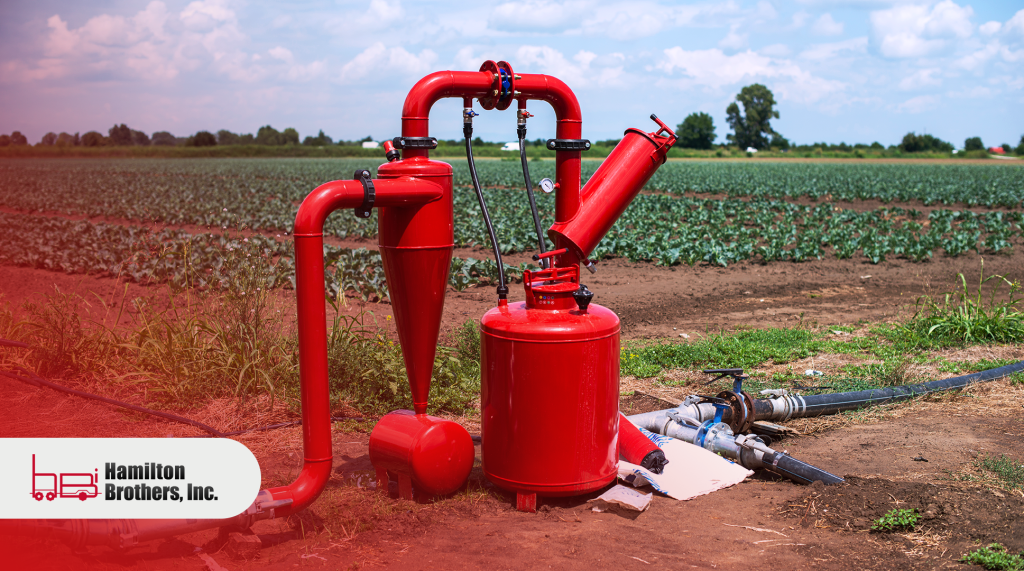
The pump is the component that determines whether an irrigation system performs the way it was designed to or fights its own limitations every season. Selecting the right irrigation well pump requires matching the pump’s capabilities to three things simultaneously: the water the well can actually produce, the volume and pressure the irrigation system requires, and the physical configuration of the property. Get all three aligned and the system runs efficiently for years. Miss on any of them, and you end up with pressure problems, premature pump failure, or energy bills that make the whole system economically painful.
Why Pump Selection Matters
Water efficiency depends heavily on whether the pump is operating within its designed efficiency range. Every pump has a performance curve showing the relationship between flow rate and pressure, with a best efficiency point where it uses the least energy per gallon delivered. A pump operating far from that point wastes energy continuously, and over a full irrigation season that inefficiency represents real money.
System reliability is directly tied to whether the pump is appropriately matched to the well and the demand. Pumps forced to operate outside their design parameters wear faster. A pump cycling excessively, running against too much system pressure, or attempting to draw more water than the well can supply will fail earlier than a properly matched pump, often significantly earlier.
Operating costs accumulate over the life of the system. Pumping is the dominant electrical cost in most irrigation operations. The difference between a well-matched pump running at high efficiency and a poorly matched one running inefficiently can amount to hundreds or thousands of dollars annually depending on the scale of the operation.
Common Types of Irrigation Pumps
Submersible Pumps
Submersible pumps are installed inside the well casing, below the water level, with the motor and pump assembly as a sealed unit. They’re the most common configuration for irrigation wells in Central Indiana at moderate depths.
Their advantages are significant. Because the pump is submerged, it’s self-priming and doesn’t struggle with suction lift limitations that surface pumps face. The water surrounding the motor provides cooling. They operate quietly since the working components are underground, and they’re protected from weather and freezing.
The trade-off is accessibility. Servicing a submersible pump requires pulling it from the well, which means equipment and labor that surface-mounted pumps don’t require. For most irrigation applications in the region, the reliability and performance advantages outweigh this consideration.
Centrifugal Pumps
Centrifugal pumps mount at the surface and draw water up through a suction line. They work well for shallow water applications, drawing from ponds or shallow water tables, and for applications where easy access for service is a priority.
Their limitation is suction lift. Physics limits how far a surface pump can lift water by suction, practically around 20 to 25 feet depending on conditions. Below that depth, a centrifugal pump can’t draw water effectively regardless of its horsepower. For Indiana irrigation wells drilled to typical depths, this makes centrifugal pumps unsuitable as the primary well pump, though they’re frequently used as booster pumps within irrigation distribution systems.
Vertical Turbine Pumps
Vertical turbine pumps combine a surface-mounted motor with a pump assembly extending down into the well on a driveshaft. They’re the standard choice for high-capacity irrigation applications where flow requirements exceed what submersibles handle efficiently.
Golf courses, large agricultural operations, and municipal-scale irrigation frequently use vertical turbines because they deliver very high flow rates and because the surface-mounted motor is accessible for service without pulling the entire pump assembly. They require a larger well diameter and a more substantial installation than submersibles, which makes them appropriate for high-demand applications and overspecified for smaller ones.
Factors That Affect Pump Selection
Water volume requirements drive the initial sizing. The calculation starts with the irrigation system’s total demand: gallons per minute required to run the zones as designed, accounting for how many zones operate simultaneously. That demand number, cross-referenced against the well’s tested sustainable yield, establishes the flow rate the pump needs to deliver and whether the well can support it directly or needs storage.
Pressure requirements are equally important and frequently underestimated. The pump must overcome the vertical lift from the water level to the surface, the friction losses through the distribution piping, elevation changes across the property, and the operating pressure the irrigation heads or emitters require at the far end of the system. Total dynamic head, which is the sum of all these factors, is what the pump is actually working against.
A pump sized on flow rate alone without accounting for total dynamic head will underperform at the far reaches of the distribution system, producing the uneven watering that plagues poorly designed irrigation installations.
Property layout affects both the pressure calculation and the practical configuration. Long distribution runs increase friction loss. Elevation changes across the property add or subtract head depending on direction. Properties with widely separated irrigation zones may benefit from a different pump configuration than compact properties with concentrated demand.
Common Irrigation Pump Problems
Low pressure at the irrigation heads is the most frequently reported irrigation pump complaint. It can result from a pump that’s undersized for the system’s total dynamic head, a pump that’s worn and no longer producing its rated performance, a well whose water level has dropped, increasing the required lift, restricted flow from a partially blocked intake or line, or leaks in the distribution system bleeding off pressure before it reaches the heads.
Accurate diagnosis requires measurement rather than assumption. Pressure readings at multiple points in the system identify where pressure is being lost.
Overheating in irrigation pumps typically points to the pump running dry or running against a closed or heavily restricted discharge. A submersible pump depends on water flow past the motor for cooling. If the well’s water level drops below the pump intake during operation, the pump loses both its water source and its cooling, and motor damage follows quickly. This scenario is why pump sizing against sustained yield rather than initial flow rate matters so much.
Overheating can also result from electrical problems including voltage imbalance, undersized wiring producing voltage drop, or a failing motor drawing excessive current.
Inconsistent flow that varies during operation or from one irrigation cycle to the next usually indicates the well is being drawn down during pumping. As the water level falls, the pump’s total lift increases and its output decreases. If the drawdown is severe enough, the flow becomes visibly inconsistent as the system operates. This is a yield problem rather than a pump problem, and the solution involves either reducing demand, adding storage, or in some cases deepening the well or drilling an additional one.
Flood damage is a cause worth calling out separately, since Central Indiana has seen significant flooding in recent years. Floodwater reaching pump electrical components, control boxes, or above-ground equipment can damage them in ways that aren’t visible from the outside. Energizing a system whose electrical components were submerged risks both a shock hazard and motor damage.
Flooding can also carry sediment into a well, damage the casing, or erode the soil around the wellhead in ways that affect the seal. If a pump system has been through high water, it should be inspected by a licensed professional before it goes back into service, and the water should be tested before the system is used.
Professional Irrigation Pump Installation
Getting pump selection right requires actual data: a tested well yield, a calculated system demand, a total dynamic head figure that accounts for the specific property, and knowledge of how different pump types perform in the geological and operational conditions the system will face.
Hamilton Bros Inc. has been sizing and installing pumps across Central Indiana since 1945. Their licensed pump installers work with Franklin Electric, Grundfos, and Pentair systems, matching pump selection to the well’s actual capacity and the irrigation system’s actual requirements rather than defaulting to a standard configuration.
Their services cover the full scope: well yield testing to establish what the source can sustain, pump sizing and selection, installation, pressure system configuration, and ongoing service when the system needs attention. For properties with yield constraints, their status as the exclusive Central Indiana dealer for Well Manager and Herculan ConstaBoost systems means they can offer solutions that other contractors in the region can’t.
If your irrigation pump isn’t delivering the pressure or volume your system needs, or if you’re planning a new irrigation installation and want the pump sized correctly the first time, that’s the conversation to have before the season starts.
Contact Hamilton Bros today to have your irrigation pump properly sized and installed by people who know the geology under your property.